
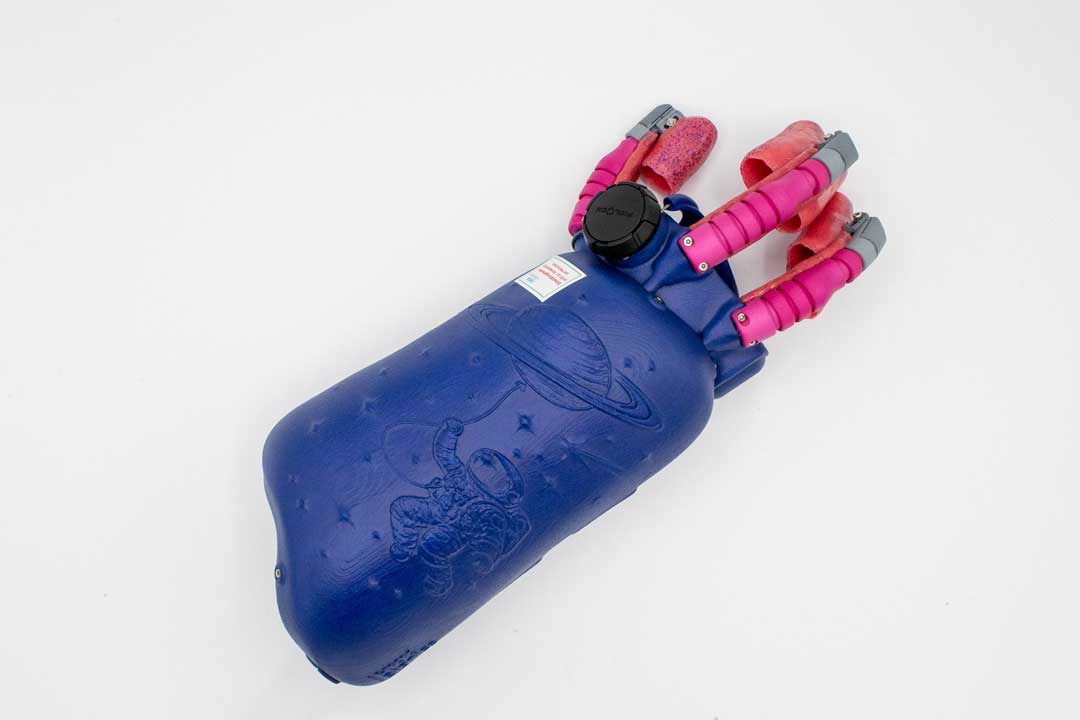
In September, the time had finally come: At REHACARE International in Düsseldorf, we presented the first prototype of our pediatric hand orthosis. With the further development of the exomotion® hand one for smaller hands and arms, we aim to potentially help make everyday life easier for children in the future and support two-handed activities.
For us at HKK Bionics, the development of the pediatric hand orthosis marks an important milestone. The trade fair prototype made it visible for the first time how the existing orthosis concept can be further developed to meet the requirements of children.
Three Motors for Five Fingers: Technology That Thinks Along
The technical basis of our new prototype is the proven exomotion® hand one, a motorized and individually manufactured orthosis for people with a paralyzed hand. A sensor on the skin detects muscle signals and translates them into movement impulses for the fingers.
For the pediatric version, we have specifically adapted the system: The prototype will use one drive less and is based on three motors. These move the fingers in groups. One motor is intended for the thumb, one for the index and middle fingers, and a third for the ring and little fingers. As the orthosis is currently still in the design and testing phase, we are developing and evaluating dedicated grip patterns for this new arrangement.
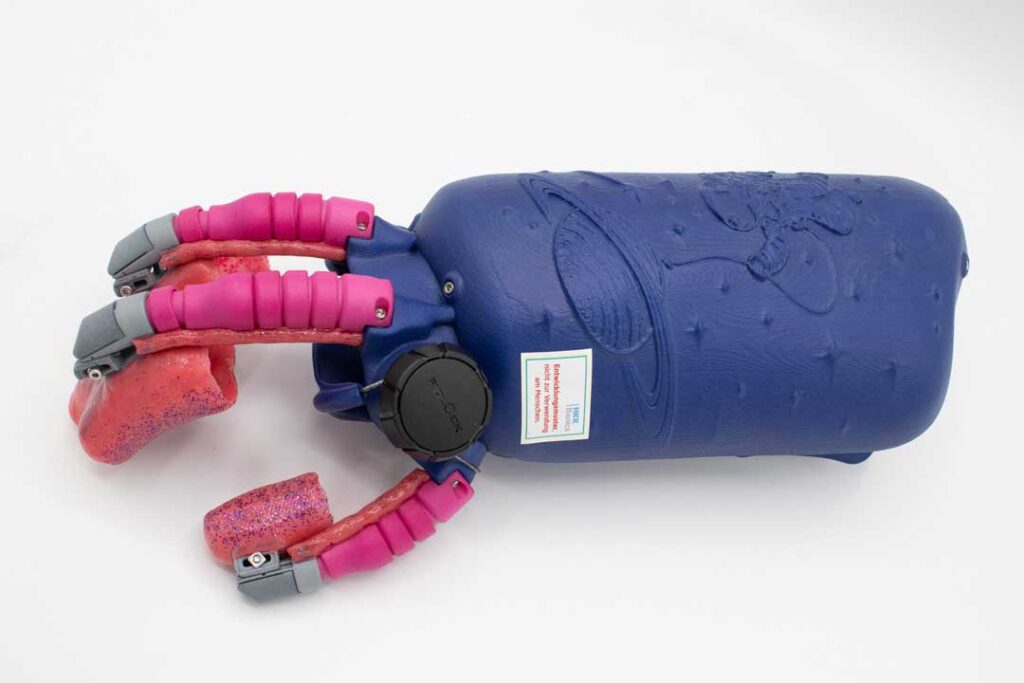
Astronaut Design for Little Explorers
An assistive device for children not only needs to be functional, it should also be visually appealing. The basis for constructing the arm splint was provided by 3D scans of two children’s hands from within our team members’ families. Building on this, we chose a cool astronaut design: The orthosis features a dark blue base color, while the exomechanics on the fingers stand out with pink elements. The silicone finger sleeves were also color-coordinated with the design concept.
New Perspectives: Being a Minor Is No Longer a Contraindication
A particularly important administrative step: Being a minor is now officially no longer listed as a contraindication for the exomotion® hand one. This means that the official documentation for the orthosis now also applies to children.
As with adult fittings, each pediatric hand orthosis is individually adapted to the arm as a custom-made device. The size of the arm plays a decisive role here, as the required technology must be safely accommodated within the orthosis. The exact minimum dimensions required are currently still being determined as part of our ongoing development and testing process and will be assessed individually as part of each fitting.